

Years ago CommonWealth Magazine in Taiwan was generous enough to publish a piece I wrote about how Taiwan needs more critical thinking in education.
The gist of the piece: “Critical thinking is important and people are going to need it more in the future than they do now. Also, that happens to be what I am selling so come get some.”
Turns out, I was right about needing it more in the future (see anything about AI). If you aren’t convinced of the imperative of robust critical thinking skills in the 2020s, then have fun bowing down to your tech bro overlords.
But for those of you who get it, the question still remains – how do we actually instill critical thinking skills in students at Englist? How does anyone really?
Writing, duh.
Our central maxim at Englist is “writing is thinking.” Oh man kids are tired of hearing me say that. But it’s also the capital-T Truth. By doing the writing you are forcing yourself to think with more depth and sharpness than you would just contemplating what is in your mind.
Don’t just take my word for it. In one of my more advanced classes we read some old blog posts by Paul Graham, a co-founder of Y-Combinator, the famous Silicon Valley venture fund. Normally I wouldn’t be perusing Graham’s work, but I was looking for something that would click with kids who are more STEM-oriented or who are skeptical that anything they learn from a lowly English teacher could be valid. And when it comes to the utility of writing as an engine for thinking, Graham and I agree.
Most people think writing is the process of recording your thoughts, and that is part of the story. But if you have ever committed yourself to writing something – an essay you cared about, a report that could make your career, a scathing Google review of a bad restaurant that no one would ever read – you know that as you write, you also come up with new ideas, you refine your ideas as you write them, and when you see your ideas written down you can adjust them to make them more powerful. In other words, when you are writing you are sharpening your thinking skills.
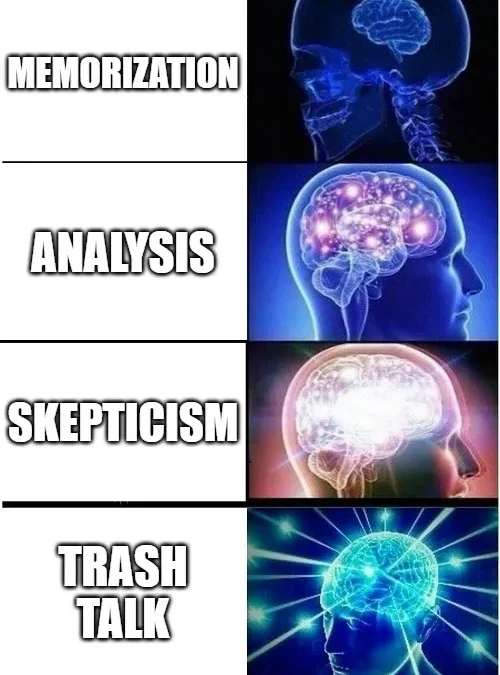
When we teach students to write, we are asking them to describe something, and even more importantly, explain why that something is happening. That is analysis. Don’t just tell me you saw a movie, tell me what happened in the movie, then tell me if the movie was good or not, and then explain why.
When we ask students to write essays, they need to read what other people have written about the topic and decide whether they agree or disagree with those writers, and then defend their stance. Is AI good for society or bad? Why do you think so? What did the Nvidia dork in the leather jacket say? What did Bernie Sanders say? Why might they say what they do? Did you form your opinion by reading science journal articles, or did you do a lot of “research” on YouTube?
When students dive into the writing process, they learn to not just be skeptical of what other people say, but they learn to be critical of their own thinking. Why do I believe what I believe? Are my ideas valid? What evidence is my opinion based on? Do I need to reconsider some assumptions I had? When students start having these thoughts, that’s the juice.
And just as important, when students write they can see their thoughts rendered in reality and then have to be critical of how they wrote it. Is it clear? Is it reasonable? Is it convincing? Is it interesting? If not, how do I change it to make it those things?
Learning how to do all that stuff with the ephemera that originates in your brain takes a long time. We start with paragraphs about your weekend, or a teacher you hate, or some good gossip at school. But over time those skills build and compound, and before you know it kids are critiquing the college application process, or writing about the enshitification of tech, or elucidating why Model UN sucks.
We know writing works as a training tool even just from hearing what kids tell us about their experience. One student was telling me his Chinese writing has improved because he has focused more on structure and clarity in English. Because structure and clarity of thought are not English-exclusive features, of course it helped his Chinese writing. We aren’t just training language skills, we are training thinking skills, agnostic of language.
Another student was telling the class that she felt writing in English is more difficult than Chinese. Sure, Chinese has more complicated words and demands a degree of flourish, but in her English work I badger her to simplify, simplify, simplify. Avoid high flying vocabulary. Break up sentences. Explain this idea more clearly. Remove this idea; it doesn’t add anything. And she has realized that the sharpening of ideas is more complicated than continuously adding new ones. (Not that Chinese writing doesn’t do this too, but I guess that’s not what she has encountered yet.)
In short, if you want to be a sharp, clear, critical thinker, you need to practice writing. So that’s what we do at Englist. But also…
We read a lot too
Kids need to be able to analyze a text if they are going to write about it. They need to be able to form opinions and defend them. They need to develop a healthy skepticism towards everything they read. They need to read more than one perspective. They need to learn to struggle through difficult texts, even when the writer hasn’t done the Lord’s work of making it clear enough for them to understand.
Then they write about what they read. See how it comes full circle?
I should note that when kids read at Englist, it may be a bit different from what people think reading is on the surface. First of all, we insist kids engage in “active reading,” meaning they aren’t just passively taking in information, but mentally engaging the text. They need to be making predictions, asking questions in their heads, noting words they don’t know and trying to understand them based on context, making judgements about characters and narration styles, blah blah blah. You get it.
But more than just active reading, we also practice what we call guided reading. I like to say this is when kids get to “borrow their teacher’s brain.” Teachers will read a page, or a paragraph, or a sentence, and students will get to listen to how the teacher says the words and emphasizes phrases. Then a student gets to read. Everyone in the classroom gets a turn. In this way, kids get to listen to an educated native speaker, they get to listen to other students, and they get to practice reading out loud themselves.
Teachers can then ask questions about the text, which students then begin to internalize. Teachers can correct mispronunciations. Teachers spot check comprehension and explain when students aren’t getting it. When teachers guide the class in reading, they are modelling the reading process for kids, which helps students develop the mental muscles for critical thinking.
In other words, the second most important way we teach critical thinking is through reading critically.
Yakity yak
I usually devote at least the first 30 minutes of class, and sometimes up to an hour, to just discussion. Interestingly, students always report enjoying the class discussion most, and if we get questions about how we use time in the classroom from parents, they are questioning the utility of that much class discussion.
The way it works is, I throw a question up in Google Classroom. Kids have 5-10 minutes to think about and write out some ideas. Then they need to respond to the question by talking to me. We go around in a circle and everyone talks (which is why it can take a long time). Next, I tell kids to think of a question for a classmate, or for me if they are not quite comfortable directly asking a classmate a question. When kids respond to questions, both mine and from other students, they are required to respond comprehensively. No shrugs. No one-word answers. No teen apathy. They need to actually talk.
About once a month I have to remind my newer classes that the purpose of class discussion is not because I am personally curious about their lives and opinions on trivia. Of course I want to get to know my students and develop a strong rapport with them, but they also need to keep in mind the purpose of discussion. So I remind them. Sometimes it feels like a wrestling match. Sometimes it turns into an hour of group trauma dumping.
For newer students, we might talk about what they did this week. Or we talk about what classes they have and how they like them. We keep it low pressure and conversational. For my Taipei Teen Tribune class, we recently discussed the philosophical problem of free will. Again, this stuff takes experience and some time to build up to, but there is a purpose to it.
Not only do kids get to listen to and practice using English in its most direct form, but they develop skills for conducting discourse, which in turn will help them become faster and more creative thinkers. It will help develop the kinds of social skills that make them more interesting to talk to and more earnest in their beliefs.
The stakes are low but the return on investment is high, so discussion is our “secret weapon” for developing critical thinking.
–
Except, it is worth saying.
This is not fancy. There is no secret. If you want to be a unique, capable, and deep thinker, you have to do the bread and butter, day-in day-out work of communication and interaction.
But so many teachers, curriculum writers, and administrators have forgotten this. Kids are inundated with drill-and-kill education-filler, or overburdened with AP this and IB that and alphabet soup jargony slop. Teachers don’t have more than a minute or two to glance at student written work, much less pull it apart and show individual students how to rebuild it. They have curriculum KPIs to hit! They have tests to prep for! Summatives or something!
The reason Englist works is because we focus on authentic learning. We write real texts. We read real books. We talk about real subjects and let kids lead the discussion as much as possible. We want education to be relevant to the lived experience of students. We want the skills they learn to be helpful and rewarding now, not just abstractions they will need for college someday.
So, I still believe critical thinking is the most important skill kids will need in the coming decades. Fortunately, the path to those skills is not complicated. It’s just good old-fashioned reading and writing and talking.