


Hot take: I loathe when my students are “productive.”
When students are being productive they are churning out work and being real busy and smart and which means they are Good and High Achieving and clap clap clap for them.
But I’ve learned that when students (and adults) are in Productive Mode, they are also in not-very-smart mode. They just want to get their work done.
On one hand, I get it. School involves exploration of topics that not everyone is going to enjoy all the time. These topics can be complex and in order to adequately comprehend and engage them, students need a degree of determination; sometimes you just gotta get it done.
But parents / teachers / administrators / policymakers have made “just get it done” the default approach in school, which in turn has led to a toxic environment where we produce products for the sake of production, where we work for the sake of work. So many students are not trying to be creative, unique, or even trying to screw around. They are thinking like machines. Just get the score. Get the grade. Move on to the next. The schedules and systems we inflict on kids turns many of them into these high-achieving, rapidly-working automatons. Their thinking becomes automatic and low-grade. Kids see an assignment, identify the task, and spit out the first thing that comes to mind.
This plays out in my class when students turn in predictable, thoughtless writing responses. As a teacher I hate that. I want kids to enjoy sharing ideas – or I want them to tell me they really hate it! I want to enjoy reading what kids write. I want kids to think about their thoughts and toy with different concepts.
But they never get to think slowly. They don’t have the psychological space to luxuriate in their imaginations. They have no time. They just need to finish the work. They need to work faster! And then when they do, we see they have finished that work so we give them more work! Anything that offers any mental respite is a distraction. Social media is a distraction. Video games are a distraction. Weekends are only useful insofar as you require them to avoid a mental breakdown, and we are still going to sign you up for classes on Saturday and Sunday!
The productive people say it too!
The thing is, I’m not the only guy in education who is saying kids need to slow down (although I might be the only one swearing about it. Not sorry). The Harvard Graduate School of Education is warning parents to stop overscheduling their kids. The former dean of Harvard College, Harry Lewis, wrote an essay titled “Slow Down.”
The fact is, doing too much means you don’t do much of it well. We see diminishing returns in overloading homework; we see this in research about multitasking, and we see it in everyday life. The kids I teach at Englist suffer under a regime of mindless overproduction.
I am not joking about their suffering either. When we talk about “at risk youths,” we presumably mean kids who come from poverty or immigrant backgrounds or histories of abuse and neglect. No one thinks the affluent kids whose parents drive them from school to soccer to science are “at risk” of anything other than being nerds. But research shows that pressure from parents, especially in terms of academic performance, can put kids at risk of “substance abuse, anxiety, and depression.”
For the mental health of your kids, for their futures, for their attitudes towards learning, we need to slow down.
“Okay,” you say, “I agree with you, but what do I actually DO?”
Ultimately society will need to grapple with the culture and systems and economies that has led us to a place where we inflict arbitrary pain on kids, supposedly for their own good. Eventually, we will need to push back against our overly productive circumstances and give students the freedom of occasional idleness (one of my favorite essays of all time is by Bertrand Russell, titled “In Praise of Idleness,” and while his piece is about the importance of idleness for society at large rather than students, the argument boils down to the same thing).
But we also live in the world we live in, so I have some tips you can glaze over if you are a Taiwanese (or international) parent and have a child or teen struggling with scheduling stress or demands to be productive all the time.
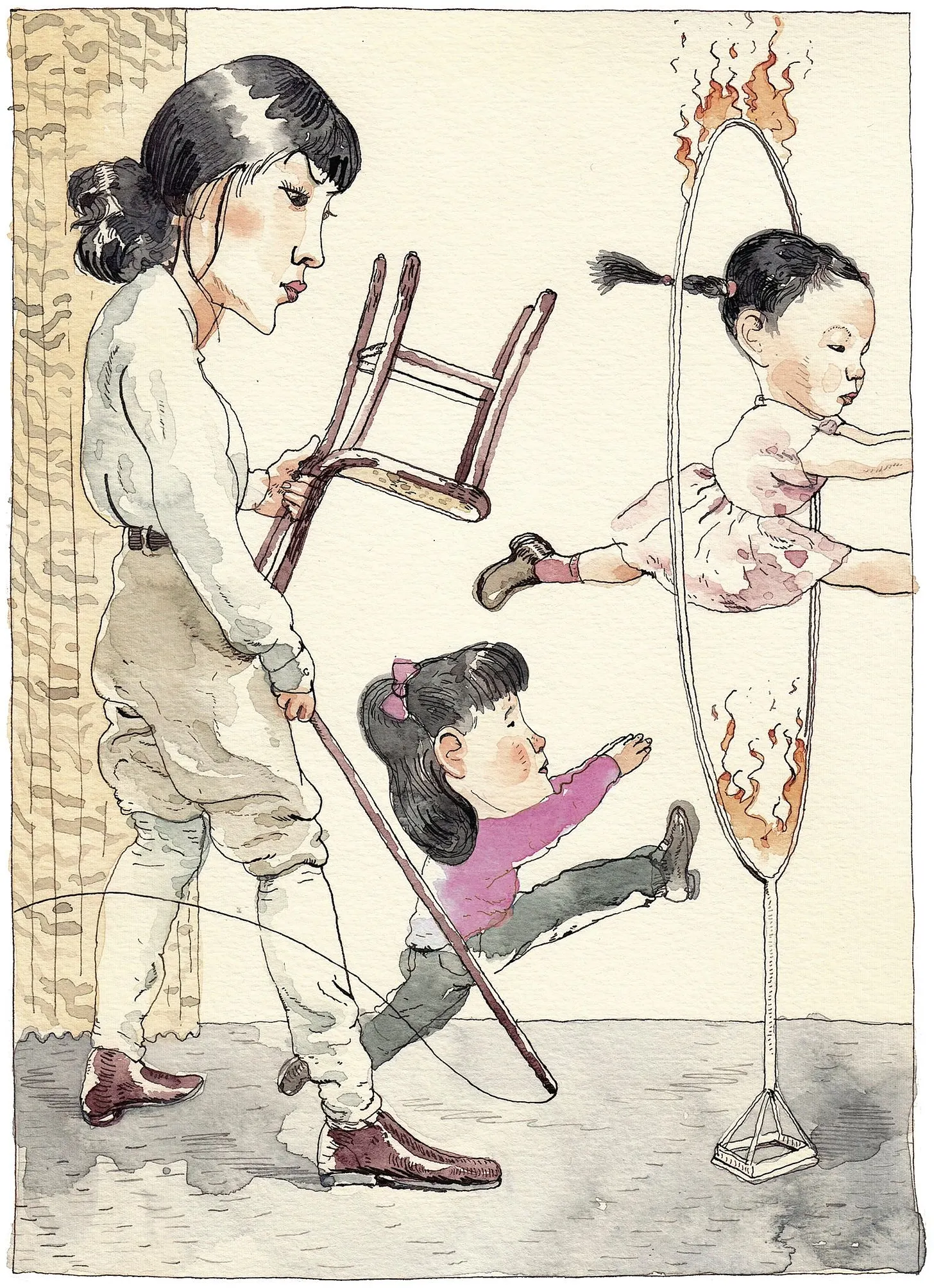
From The New Yorker
The first thing parents need to do is acknowledge you are fighting against the current. Your kids’ schools, your other parent friends, all of society is telling you to make your kids do more. You are going to have to be mindful and resilient if you want to make things better for your kids.
You might also have to talk to teachers, principals, and your kids themselves to get them to understand why you want to protect your child’s time.
But then, of course, you still have to consider day-to-day reality. Kids want to do sports and classes with their friends. They probably need some hobbies and will almost certainly need extra academic help at some point. What looks good on a college application? What is an impressive hobby for a kid to have? Those are valid questions. But how much is too much?
Let’s break down priorities into different levels:
Level 1: Health requirements
Sleep (8h), meal times (not rushed), some downtime on weekends, family time (1-2 evenings per week)
- This section is non-negotiable. If they are not getting enough sleep, if they are so rushed they can’t sit down to eat in peace, and if they have no downtime at all, your kids are at serious risk of mental health problems.
- Kids also need to be getting some exercise – most health commissions say 60 minutes a day in total, and we talk about that over at the Englist blog, but that’s also a whole different conversation.
Level 2: Basic priorities
Homework and study time (grade level x 10 minutes per night on average)
- If school isn’t a top priority, you aren’t having a serious conversation. But, how much time makes sense for your kids to focus on school – especially after school – each day? You should consider cram schools that assist kids with schoolwork to be part of “school” even if they are in different locations.
- Research has shown a good guideline to be 10 minutes per grade level per day. So if your student is in 8th grade, that is an average of 1 hour 20 minutes of homework or studying per night.
- If they are doing more than that on a regular basis, is it because of their lack of focus, or is it because they have too much work to do? Generally speaking, some kids can be taught to focus and become better organized, but oftentimes when kids are not focused, it’s because they are overloaded and feel overwhelmed.
Level 4: Extra priorities
Tutoring, extra classes
- Once you have school work out of the way, the rest of your kids’ schedule is a matter of priority. If you plan on sending your child overseas for school in the future, I would vociferously argue that your top priority should be Englist. The format of our classes, the skills we emphasize, and the level of attention your student will get will help bridge the gap better than anything else I have seen in Taiwan. I wish I would have had more courses like Englist when I was in junior high and high school.
- But even if your kids don’t attend my program, making sure your kids are enrolled in English-language programs is essential. Beyond that, you need to decide where your student needs the most help, and what activities are going to be the most worthwhile in the long run. What subjects does your student enjoy? Or, on the other side of the coin, what subjects does your student struggle with so much that it could impact their grades? Sometimes kids might want to do badminton and martial arts and drawing class, but doing all three just isn’t practical. You might just have to pick one. Or if your high school student struggles in math and has no interest in being a doctor or engineer, perhaps make peace with them earning B’s rather than inflicting tutoring on them that they will loathe.
Level 5: Extracurriculars
One sport or physical activity, one hobby (art, music, games, computers, etc.) – unless you have more time
- In modern life for busy kids, all they likely have room for is one sport and one hobby – if they are lucky. So, think table tennis one evening and one weekend afternoon, and then piano class once a week. Or something like that.
- If you don’t have time for one of each, that is probably worth paying attention to as your kid might be overscheduled elsewhere. Sure, school is a higher priority, but if school is taking up so much of a kid’s time they can’t have hobbies and enjoy their pursuit, maybe something else is wrong. Is a teacher assigning too much work? Is the student not actually focusing while doing homework? Or, perhaps some of their study time is redundant.
Level 6: Remainder
Leave this entirely up to the kids
- In the off chance that your kids are getting solid grades, participating in at least one necessary extra curricular, one sport, and one hobby, the rest of their time really should be theirs. This doesn’t mean you have to surrender all of this time to video games or social media, but it really is in this “remainder” time where kids have the space to develop the creativity and thoughtfulness we want for our kids.
Obviously there is wiggle room in this formula, and each kid and family is different.
However, they aren’t that different. In my years as a teacher, the happiest, healthiest kids had schedules that looked like this. The kids that were the most stressed, browbeaten, and bored were kids who were overscheduled.
If you can manage your child’s physical needs and mental health, and they can manage their schoolwork and a few outside activities, that is as productive as they need to be. The rest of the time they need to be kids and experience some freedom. That is where the meaningful development happens.
Mr. Hatch